

```html
As someone who has walked the halls of residential care and sat on both sides of the table, I know that the word "allegation" is perhaps the most frightening term in a professional’s vocabulary. It’s a moment where time seems to stop, and your commitment to the children you care for feels suddenly questioned.
Whether you are a support worker, a foster carer, or a parent, understanding the "why" and "how" of this process is the first step toward finding your footing again.
Table Of Contents
Why Do Allegations Happen?
Allegations in social care often arise from a place of protection—even if they feel like an attack. In the social care ecosystem, the "safeguarding first" principle is absolute.
- Communication of Trauma: For many children in care, words aren't their first language; behavior is. An allegation may be a way for a child to express past trauma, test boundaries, or exert control in a world where they feel powerless.
- Observations by Others: A colleague or another professional may observe an interaction that they don't fully understand and are legally bound to report.
- Mandatory Reporting: We work in a "low-level concern" culture. This means even minor inconsistencies must be flagged to ensure nothing is missed.
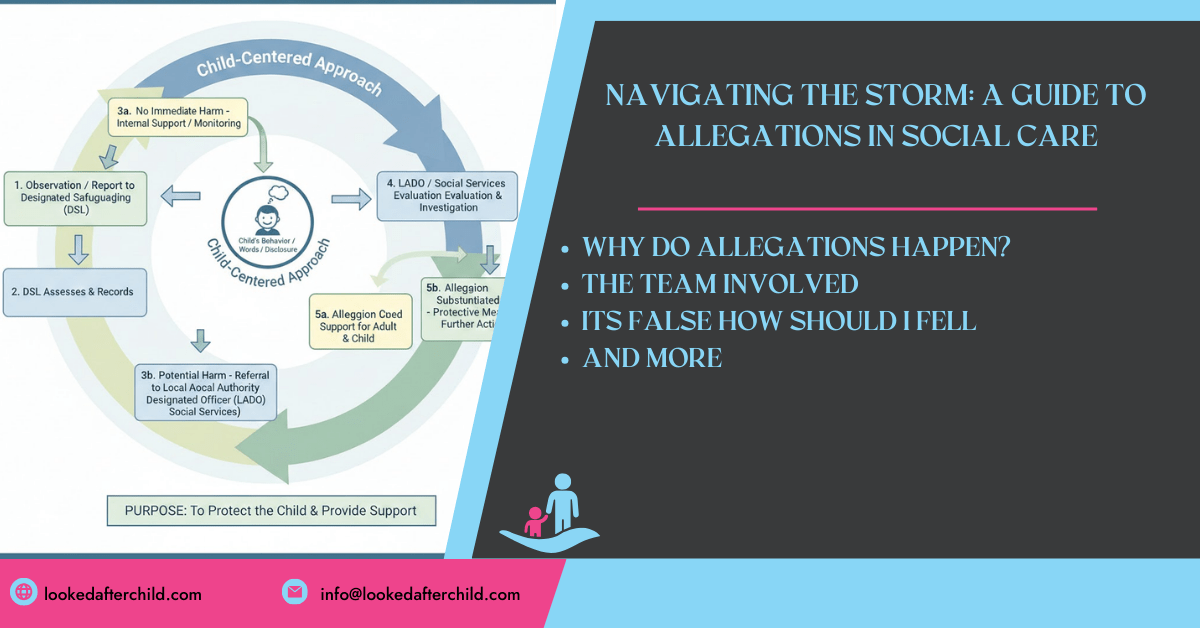
When an allegation is made, a specific machinery starts to turn. You aren't just dealing with your manager; you are dealing with a multi-agency response.
- The LADO (Local Authority Designated Officer): They are the "conduct referee." The LADO’s job is to oversee all allegations against people who work with children. They ensure the investigation is fair, thorough, and timely.
- The Police: If the allegation involves a potential crime, the police will lead the investigation to see if any laws were broken.
- Social Workers: Their primary focus remains the child’s immediate safety and emotional well-being throughout the process.
"It’s False—How Should I Feel?"
If you know the claim is untrue, you will likely feel a mix of betrayal, anger, and profound sadness. It is vital to remember: Feeling this way does not make you guilty. It makes you human. It is incredibly painful to have your integrity questioned when you have dedicated your life to helping others. Allow yourself to feel these emotions, but try to lean on professional support rather than reacting impulsively.
What Happens During an Allegation?
- Initial Evaluation: The LADO and your employer decide if the threshold for an investigation has been met.
- Possible Suspension: You may be suspended or moved to "non-client facing" duties. Suspension is a neutral act—it is intended to protect everyone involved, not to punish you.
- The Investigation: Interviews will be conducted, and evidence (like daily logs or CCTV) will be reviewed.
What if the Allegation is "Substantiated"?
If the investigation finds the allegation to be "substantiated," it means there is sufficient evidence to prove the incident happened.
- Disciplinary Action: This could lead to a formal warning or dismissal.
- Referrals: Depending on the severity, a referral might be made to the Disclosure and Barring Service (DBS) or professional bodies.
- Support: Even at this stage, you have the right to union representation and a clear explanation of the findings.
Can I Appeal the Decision?
Yes. You generally have the right to appeal the outcome of a disciplinary process through your employer’s internal HR procedures. While you cannot usually "appeal" a LADO’s conclusion directly in the same way, you can challenge the fairness of the process or provide new evidence that wasn't previously considered.
Moving On: Working with the Child After a False Allegation
This is perhaps the hardest part of the journey. If an allegation is found to be "malicious" or "unfounded" and you return to work with that same child, the relationship has changed.
- Professional Boundaries: You may feel the need to be more "by the book." This is a natural survival instinct.
- Restorative Practice: If appropriate, a managed "restorative" meeting can help clear the air. It allows the child to understand the impact of their actions and helps you rebuild a sense of safety.
- Therapeutic Support: Do not try to carry this alone. Use clinical supervision to process the "secondary trauma" of being accused.
Remember: Your value as a professional is not defined by the fact that an allegation was made, but by the integrity and resilience you show as you move through i
```
0 Comments