

In the social care sector, data protection is not merely a bureaucratic requirement; it is a fundamental component of digital safeguarding. For those looking after children—whether in residential settings, foster care, or kinship care—the information we hold is often the most sensitive data imaginable. Handling this data correctly is a direct reflection of our commitment to the safety and privacy of the vulnerable children in our care.
As the Founder of Looked After Child, I have managed residential settings where the “Dual Lens” of professional compliance and lived experience informed every decision. This guide provides an executive-level framework for navigating the UK General Data Protection Regulation (UK GDPR) and the Data Protection Act 2018 (DPA 2018) within the 2026 digital landscape.
Table Of Contents
The Foundation: Why Data Protection is Safeguarding
The DPA 2018 and UK GDPR are designed to ensure that personal data is processed fairly, lawfully, and transparently. In our sector, “personal data” includes anything from a child’s placement history to their medical records and daily logs.
Failure to protect this data isn’t just a legal risk; it’s a safeguarding failure that can compromise a child’s “digital footprint” and their physical safety.
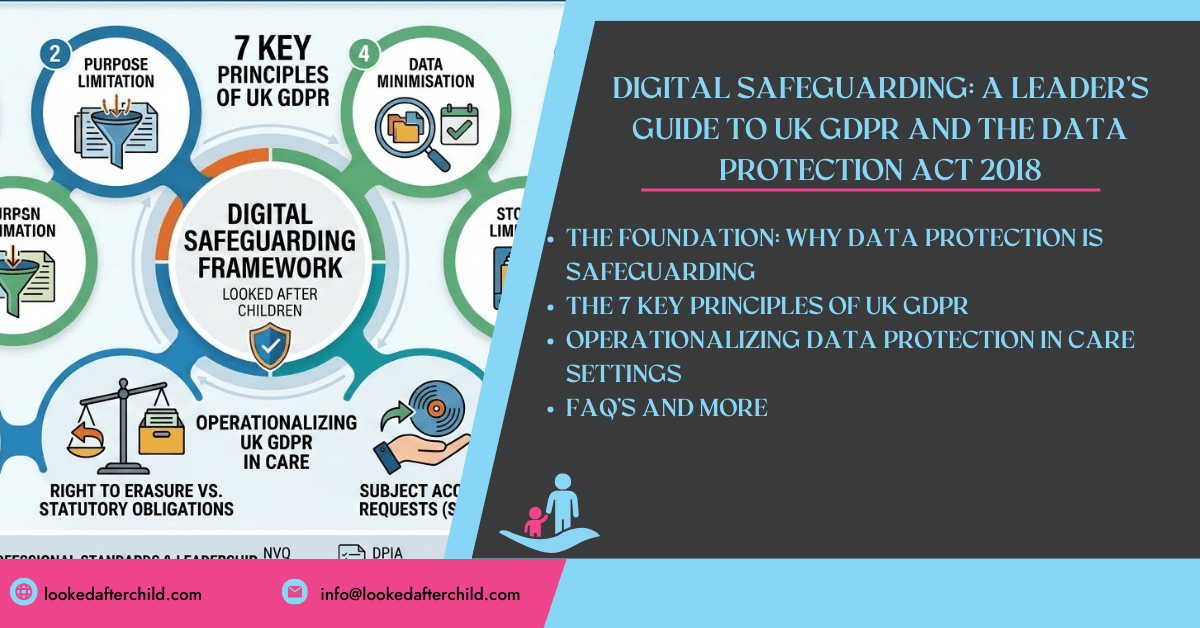
The 7 Key Principles of UK GDPR
To maintain high standards of E-E-A-T (Experience, Expertise, Authoritativeness, and Trustworthiness), every care professional must embed these seven principles into their daily practice:
- Lawfulness, Fairness, and Transparency: You must have a valid legal reason to process a child’s data and be open about how it is used.
- Purpose Limitation: Data should only be collected for specified, explicit, and legitimate purposes (e.g., fulfilling a Care Plan).
- Data Minimisation: Only collect the data that is strictly necessary. If you don’t need to know a specific detail to provide care, don’t record it.
- Accuracy: Records must be kept up-to-date. Inaccurate data in a social care context can lead to poor decision-making for a child’s future.
- Storage Limitation: Do not keep personal data longer than is necessary. Follow your local authority’s retention schedules strictly.
- Integrity and Confidentiality (Security): This is the “Security Principle.” Use encrypted devices, secure passwords, and never share sensitive files over unencrypted platforms.
- Accountability: As a leader or carer, you must be able to demonstrate how you are complying with these principles.
Operationalizing Data Protection in Care Settings
Moving from theory to practice requires a trauma-informed, operational approach. Here is how we translate the DPA 2018 into the “House Manager” reality:
1. Managing “Special Category” Data
Health data, racial or ethnic origin, and religious beliefs are classified as Special Category Data. This requires higher levels of protection. Ensure that access to these files is restricted only to those who “need to know” to provide effective care.
2. The Right to Erasure vs. Statutory Obligations
Children have the “right to be forgotten,” but in social care, this is often superseded by statutory requirements to maintain records for several decades (often up to 75 years after a child leaves care). It is vital to explain this distinction to young people in an age-appropriate, transparent way.
3. Subject Access Requests (SARs)
Care-experienced individuals have a right to access their records. When processing a SAR, we must redact third-party information to protect the privacy of others while ensuring the individual receives the clarity they deserve regarding their own history.
In 2026, a child’s digital footprint is a major concern. Avoid posting identifying information, school uniforms, or location-tagged photos of children in care. This aligns with the UK Online Safety Act and prioritizes the long-term privacy of the child.
Professional Standards & Leadership
As professionals with NVQ Level 4 standards or higher, our role is to act as the “Data Controller” or “Data Processor” with the utmost integrity. This means:
- Conducting Data Protection Impact Assessments (DPIA) before introducing new tracking software or apps.
- Reporting any data breaches to the Information Commissioner’s Office (ICO) within 72 hours if the breach poses a risk to the rights and freedoms of the child.
By treating data with the same respect we treat the children themselves, we move from mere “compliance” to a culture of systemic safety.
Frequently Asked Questions (FAQ)
Q: Can I share a child’s information with their teacher without a formal meeting? A: Yes, if it is in the child’s best interest and falls under the “Lawfulness” principle (e.g., providing necessary support). However, ensure you only share what is relevant and record the disclosure in the child’s file.
Q: What should I do if I lose a work phone containing sensitive reports? A: This is a data breach. You must immediately notify your Data Protection Officer (DPO) or Manager so the device can be remotely wiped and the incident can be assessed for reporting to the ICO.
Q: Does a foster parent need to register with the ICO? A: Generally, no. Foster parents are usually seen as an extension of the fostering agency or local authority, who act as the Data Controller. However, you must still adhere to the agency’s data protection policies.
Q: Can a young person ask to see their daily logs? A: Yes. Under the UK GDPR, they have a right to access data held about them. This should be handled sensitively, often with a professional present to help them process the information.
Q: How do I handle data protection when using AI tools for report writing? A: Never input identifiable data (names, specific dates, addresses) into public AI tools. If your organization uses a “closed” AI environment, follow their specific security protocols.

0 Comments