

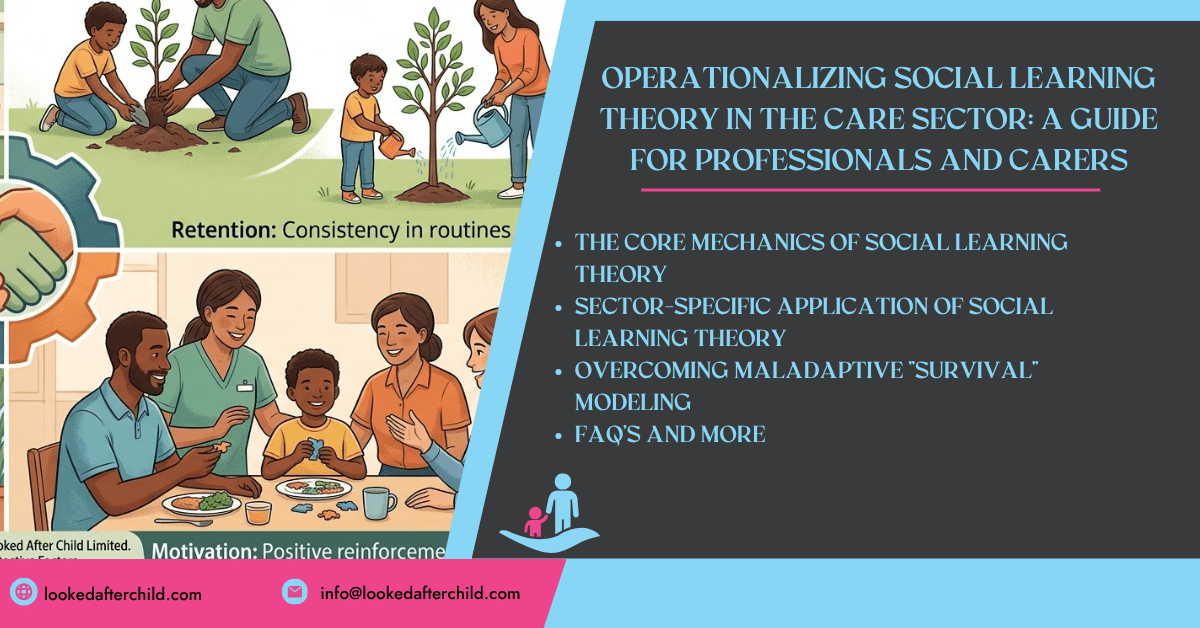
Social Learning Theory, pioneered by Albert Bandura, establishes that individuals learn behaviors, emotional reactions, and attitudes through the observation and imitation of others. For professionals and carers looking after children, this theory is not just an academic concept; it is the operational framework that dictates how a child's environment, and the adults within it, serve as the primary blueprint for their neurological and behavioral development. By understanding and actively managing the behaviors we model, we can systematically dismantle trauma responses and build protective factors that ensure long-term placement stability.
Hello, I am Li Jean-Luc Harris, Founder and Director of Looked After Child Limited. Through my Dual Lens—drawing on over seven years of frontline health and social care experience, maintaining NVQ Level 4 standards, managing residential homes, and my own journey as a care-experienced survivor—I have witnessed the profound impact of observational learning. Children in the care system do not simply listen to the rules we set; they absorb the realities we live.
This comprehensive guide is designed to equip Foster Parents, Kinship Carers, Residential Workers, and Social Workers with trauma-responsive tools to harness Social Learning Theory for systemic, positive change.
Table Of Contents
- 1 The Core Mechanics of Social Learning Theory
- 2 1. Attention: The Hyper-Vigilant Learner
- 3 2. Retention: Building New Neural Pathways
- 4 3. Reproduction: Creating Psychological Safety
- 5 4. Motivation: Moving from Survival to Thriving
- 6 Sector-Specific Application of Social Learning Theory
- 7 For Foster Parents and Kinship Carers
- 8 For Residential Workers and House Managers
- 9 For Social Workers
- 10 Overcoming Maladaptive "Survival" Modeling
- 11 Frequently Asked Questions (FAQs)
To effectively apply this theory within a trauma-informed framework, we must first understand its four foundational pillars. Children who have experienced early adversity are often highly attuned to their environments, making these four stages critical to their development.
1. Attention: The Hyper-Vigilant Learner
Before a behavior can be learned, it must be noticed. Children in the care system often operate from a place of hyper-vigilance, an adaptive survival mechanism. They pay acute attention to adult interactions, tone of voice, body language, and conflict resolution.
- The Professional Insight: As carers and professionals, we must ensure that the behaviors we want to see—such as de-escalation, patience, and active listening—are highly visible and consistently demonstrated.
2. Retention: Building New Neural Pathways
Observation alone is insufficient; the child must remember the behavior. Complex developmental trauma can impact cognitive processing and memory retention.
- The Professional Insight: Repetition and routine are your most powerful tools. A single instance of positive emotional regulation will not overwrite years of maladaptive survival modeling. Consistent, predictable responses to stress from the adults in the home create the safety necessary for retention.
3. Reproduction: Creating Psychological Safety
Reproduction is the child’s ability to perform the observed behavior. A young person may observe you calmly resolving a dispute, but if their central nervous system is dysregulated, they physically cannot reproduce that calmness.
- The Professional Insight: We must scaffold their ability to reproduce positive behaviors. This means co-regulating with the child, providing them with the vocabulary for their emotions, and offering a psychologically safe environment where mistakes are viewed as learning opportunities, not punishable offenses.
4. Motivation: Moving from Survival to Thriving
A child must have a reason to adopt a newly observed behavior. In many cases, their previous, maladaptive behaviors (such as aggression or withdrawal) successfully kept them safe in dangerous environments.
- The Professional Insight: We must ensure that positive behaviors yield better outcomes than survival behaviors. This requires moving away from strictly punitive measures and focusing on positive reinforcement, relational connection, and acknowledging the effort a child makes to regulate themselves.
How we apply these principles varies depending on our specific role within the child's life. However, the overarching goal remains the same: modeling safety, stability, and emotional intelligence.
For Foster Parents and Kinship Carers
The home is the primary theater of learning. Everyday interactions are profound teaching moments.
- Model "Rupture and Repair": It is essential that children see adults disagree respectfully, apologize, and repair relationships. If you lose your patience, verbally acknowledge it: "I was frustrated, and I raised my voice. I am sorry, and I will take a deep breath next time." This models accountability and emotional regulation.
- Narrate Your Regulation: Speak your coping mechanisms out loud. "I am feeling overwhelmed by this traffic, so I am going to turn on some calming music and take a few deep breaths."
For Residential Workers and House Managers
In a residential setting, the dynamics between staff members are scrutinized heavily by the young people in your care.
- Unified Front: Splitting behaviors (where a child plays one staff member against another) are common. Staff must model unified, consistent communication during handovers and daily operations.
- Milieu Therapy: The entire environment must be therapeutic. The way staff members speak to one another, handle crisis interventions, and share meals sets the operational standard for the young people. As a former House Manager, I can attest that staff cohesion is directly correlated with a reduction in critical incidents.
Social workers serve as the bridge between the child, the carers, and the systemic framework.
- Assessing the Modeling Environment: When reviewing a placement, assess the implicit behaviors being modeled. Is the foster family modeling healthy boundaries? Are the residential staff modeling proactive or reactive care?
- Advocating for Carer Support: Carers cannot model regulation if they are entirely burnt out. Advocating for respite, therapeutic support, and robust training for carers is a direct intervention in the child's social learning environment.
Overcoming Maladaptive "Survival" Modeling
One of the greatest challenges in our sector is supporting a child who has spent years internalizing negative models. When a child resorts to property damage, verbal abuse, or self-harm, they are often reproducing the only conflict resolution tools they were ever taught.
To counter this, we must employ Aggressive Consistency. The child's brain will test the new, positive environment to see if the old rules still apply. If a child attempts to provoke rejection (a learned expectation), the carer must consistently model unconditional positive regard and firm, safe boundaries. This contrast between what the child expects (rejection/anger) and what they receive (compassion/boundaries) is where cognitive restructuring and true healing occur.
Frequently Asked Questions (FAQs)
Q: How long does it take for a child to unlearn trauma responses and adopt the positive behaviors we are modeling? A: There is no set timeline, as it depends on the child's age, the duration of their trauma, and their neurobiology. However, neurological shifts generally require months to years of consistent, predictable modeling. Focus on micro-progressions, such as a child taking a deep breath before shouting, rather than expecting immediate, total behavioral overhauls.
Q: What do I do if the young person is mimicking negative behaviors from peers at school or in the residential home? A: Peer modeling is incredibly influential, especially in adolescence. Do not attack the peer, as this often causes the young person to defend them. Instead, foster open dialogue about the behavior itself. Ask, "How did it make you feel when that happened?" and continuously model and praise the alternative, positive behaviors within your own environment.
Q: How can I model emotional regulation when I am experiencing extreme stress or secondary trauma myself? A: You cannot pour from an empty cup. If you are deeply dysregulated, it is safer and more professional to tag out or take a pause. Say to the child, "I am feeling too frustrated to solve this right now. I am going to step away for ten minutes to calm down, and then we will figure it out together." This actively models boundary-setting and self-care.
Q: Does Social Learning Theory mean the child's past trauma is entirely responsible for their current choices? A: Trauma explains the behavior; it does not excuse it. Social Learning Theory helps us understand the origin of the child's toolkit. Our role is to provide a new toolkit and hold them compassionately accountable as they learn to use it, empowering them to rewrite their own ending.

0 Comments