

“`html
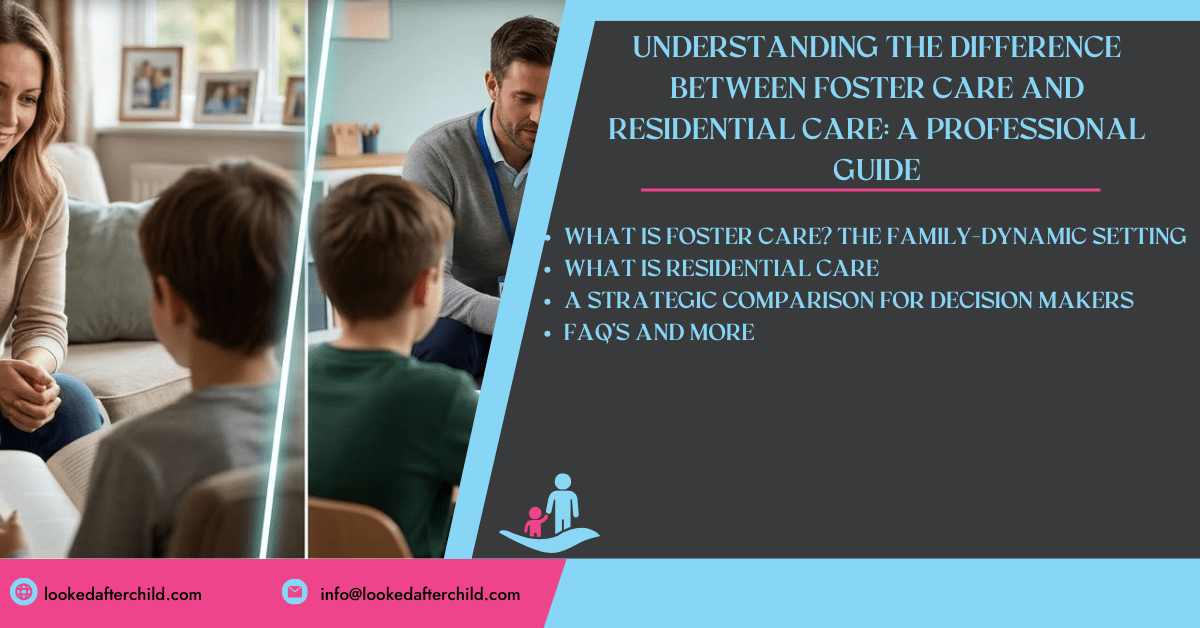
The primary difference between foster care and residential care lies in the environmental structure and the framework of therapeutic support. Foster care places a child within a family home environment with approved foster carers, offering a highly personalized, family-dynamic setting. Residential care, conversely, provides a structured, staff-led environment in a specialized children’s home, supported by a rotating team of trained professionals. While foster care is designed to mimic a traditional family unit, residential care is often utilized as a highly structured, therapeutic intervention for children who require a specialized milieu that a single family home cannot provide.
In 2026, our sector’s success depends on understanding why users search rather than what exact words they type. We must move beyond outdated stigmas and match content depth to the true intent of our care strategies.
Drawing from over seven years of frontline professional experience —including my tenure as a residential House Manager overseeing complex care operations—and guided by the resilience of my own care-experienced journey, this guide breaks down the operational, legislative, and trauma-responsive distinctions between these two vital pillars of the social care sector. By including real-world experience and clear author credentials, we aim to strengthen this content’s credibility and E-E-A-T signals.
Table Of Contents
What is Foster Care? The Family-Dynamic Setting
Foster care is the most common placement type for looked-after children. It is designed to provide a safe, nurturing, and stable family environment when a child cannot live with their birth parents.
Operational Structure
In foster care, individuals or couples (foster carers) are rigorously assessed, trained, and approved by a Local Authority or an Independent Fostering Agency (IFA). The child moves into the foster carer’s own home, integrating into their daily life, routines, and family dynamics.
The Trauma-Informed Lens
From a trauma-responsive perspective, foster care relies heavily on Attachment Theory. The primary therapeutic tool is the consistent, available, and attuned relationship provided by the primary caregivers.
- Strengths: Provides normative community experiences, individualized attention, and the opportunity to build a secure attachment figure in a traditional home setting.
- Challenges: Children with profound developmental trauma or severe behavioral dysregulation may find the intimacy of a family home overwhelming. The pressure of a nuclear family dynamic can sometimes trigger complex trauma responses, leading to placement breakdown if the carers are not adequately supported.
What is Residential Care? The Therapeutic Milieu
Historically, residential care was sometimes viewed incorrectly as a “last resort.” As a former House Manager operating to strict NVQ Level 4 standards, I actively challenge this narrative. Modern residential care is a highly specialized, proactive choice for young people requiring intensive support.
Operational Structure
Residential care takes place in a registered children’s home. Unlike a foster home, this is a neutral, professionally managed environment. Care is provided by a multidisciplinary team of residential workers, team leaders, and managers operating on a rota system. The home is subject to stringent regulatory oversight (e.g., Ofsted in England) to ensure compliance with quality standards.
The Trauma-Informed Lens
The primary therapeutic tool in residential care is the milieu—the environment itself.
- Strengths: The team approach means that if a young person is highly dysregulated, the emotional load is shared among trained professionals rather than resting on a single foster parent. It provides distinct boundaries, consistent routines, and often integrates on-site therapeutic and educational support. It removes the “pressure to attach” to a single parental figure, which can feel much safer for adolescents with severe relational trauma.
- Challenges: The rotating staff team can make building deep, individual attachments slower. Transitions out of residential care into independence require meticulous, long-term planning to ensure the young person does not experience a sudden loss of their support network.
A Strategic Comparison for Decision Makers
To support social workers, commissioning teams, and care professionals in their assessments, we must structure content clearly with headings and subheadings. Here is a high-level operational breakdown:
| Feature | Foster Care | Residential Care |
| Primary Environment | A private, family home. | A specialized, registered children’s home. |
| Caregivers | Approved foster carers (individuals/couples). | A multidisciplinary team of trained staff on rotation. |
| Relational Focus | Primary attachment to a parental figure. | Distributed attachment across a professional team; focus on peer and group dynamics. |
| Intervention Level | Nurturing, family-based recovery. | High-acuity, structured intervention; designed for complex trauma. |
| Regulatory Oversight | Supervising social worker, unannounced visits, annual reviews. | Highly regulated statutory inspections (e.g., Ofsted), strict shift documentation. |
4. The Dual Lens Perspective: Making the Right Match
As professionals, our mandate is placement stability. Disruption is re-traumatizing. Therefore, the decision between foster and residential care must never be driven purely by finances or a lack of beds; it must be driven by the child’s assessed needs.
Through my Dual Lens—having navigated these systems both as a vulnerable young person and later as the professional holding the keys—I understand that the “best” placement is entirely subjective. A beautifully loving foster home can be the wrong environment for an adolescent who needs the neutral boundaries of a residential setting to decompress. Conversely, a highly-rated residential home cannot replace the deep, localized community integration that a skilled foster family provides a younger child.
5. Moving Forward: Systemic Change in 2026
We must continue to advocate for a system where residential care and foster care are viewed as equal, complementary arms of the same protective body. By raising the standards of training across both sectors, we equip carers and professionals to rewrite the ending for the children we look after.
Frequently Asked Questions (FAQ)
Q: Is residential care only used when foster placements break down?
A: No. While it is sometimes used following a breakdown, best practice dictates that residential care should be a proactive, first-choice placement for children whose trauma assessments indicate they need a highly structured, team-based therapeutic environment rather than a family dynamic.
Q: Can a child move from residential care back into foster care?
A: Yes, this is known as a “step-down” placement. It requires meticulous transition planning, extensive communication between the residential team and the new foster carers, and a phased introduction to ensure the child feels safe and the placement is stabilized.
Q: What qualifications do staff in residential care need compared to foster carers?
A: Foster carers undergo extensive assessment (such as the Form F in the UK) and mandatory ongoing training, but do not strictly need formal academic qualifications to begin. Residential care workers are typically required to hold or be working towards specific professional qualifications, such as the Level 3 or NVQ Level 4 Diploma in Residential Childcare, ensuring a standardized level of professional practice.
Q: How does Looked After Child Limited support both sectors?
A: We provide trauma-informed training, operational consultancy, and systemic advocacy for both foster carers and residential teams. Our goal is to unify the sector through shared, high-level standards of care and managed lived-experience insights.
“`
0 Comments