

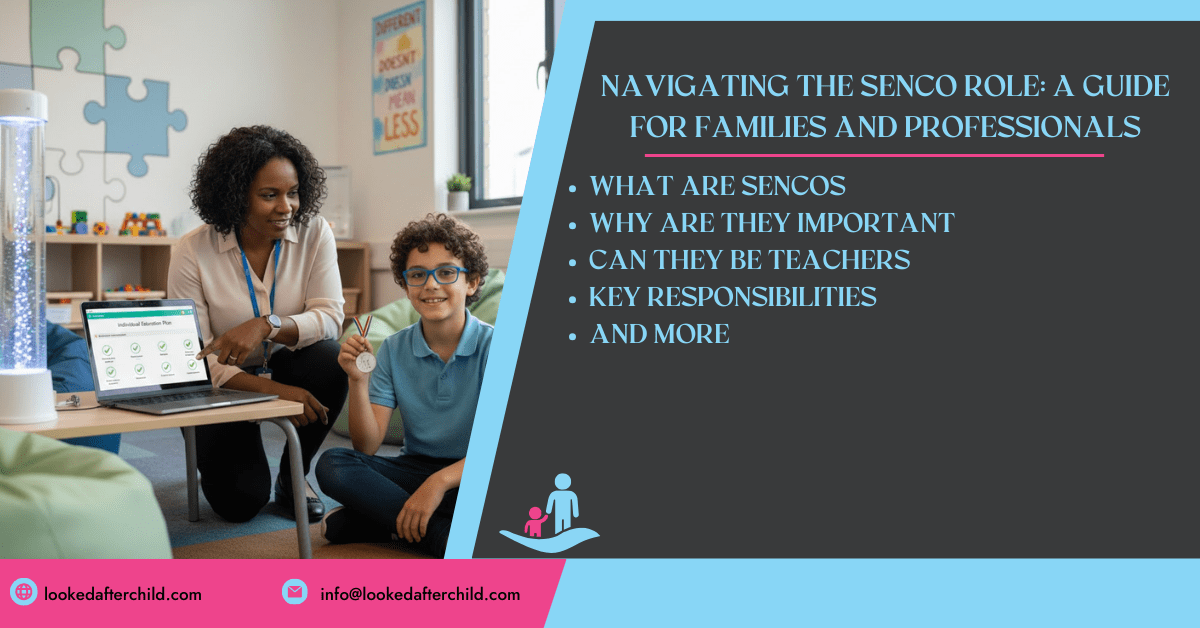
In my years working within the care system and sharing life stories, I’ve seen how pivotal one person can be in changing a child’s trajectory. When a child has additional needs, that person is often the Special Educational Needs Coordinator, or SENCO.
Understanding this role is vital whether you are a parent feeling overwhelmed by the “system” or a professional looking to better support a child in your care.
Table Of Contents
What is a SENCO?
A Special Educational Needs Coordinator (SENCO) is a designated teacher responsible for managing the provision for children with Special Educational Needs and Disabilities (SEND) within a school. They act as the central hub, ensuring that every child who learns differently gets the specific support they require to thrive.
Why is a SENCO Important?
For a child in care or a child with SEN, the school environment can sometimes feel like a puzzle where the pieces don’t quite fit. The SENCO is the “puzzle master.” They are important because:
- Advocacy: They ensure the child’s voice is heard and their rights are upheld.
- Legal Compliance: They make sure the school follows the SEND Code of Practice.
- Resource Allocation: They identify what extra help—like speech therapy or 1-to-1 support—is needed.
Can SENCOs Be Teachers Too?
Yes. In fact, in the UK, a SENCO must be a qualified teacher. While in very large schools the SENCO might focus purely on leadership, in many settings, they balance their coordinator duties with regular classroom teaching. This helps them stay grounded in the practical realities of the classroom.
Key Responsibilities of a SENCO
The role is broad, blending administrative expertise with deep empathy:
- Strategic Oversight: Developing and daily-running the school’s SEND policy.
- Coordinating Provision: Mapping out what support each child receives.
- Liaising with Parents: Acting as a bridge between the school and home to ensure families feel supported.
- Professional Support: Advising and training other teachers on how to adapt their lessons.
- External Links: Working with local authorities, educational psychologists, and health professionals.
Qualifications: How Do I Become a SENCO?
To step into this vital role, you need a specific professional foundation:
- Qualified Teacher Status (QTS): You must first be a licensed teacher.
- The National Award: Most new SENCOs must complete the National Award for SEN Coordination (a postgraduate qualification) within three years of taking the post.
- Experience: Deep “lived experience” in the classroom is essential to understand how different needs manifest in a learning environment.
Li’s Insight: If you’re a support worker or teacher looking to become a SENCO, your most valuable asset is your ability to see the child behind the “label.” The paperwork can be taught; the empathy is what makes you effective.
Can a SENCO Diagnose a Child?
No, a SENCO cannot provide a medical diagnosis (such as Autism, ADHD, or Dyslexia). Diagnosis is a clinical process performed by medical professionals like pediatricians or educational psychologists. However, a SENCO can carry out internal assessments to identify learning gaps and, most importantly, they are the ones who refer a child for a formal external assessment.
How Do They Help Children?
The SENCO helps children by creating an environment where “different” doesn’t mean “less”:
- Individual Education Plans (IEPs): They create tailored goals so the child experiences the “win” of achieving milestones.
- Adaptive Technology: Providing tools like laptops or sensory equipment.
- Safe Spaces: Setting up nurture groups or quiet zones for children who experience sensory overload.
Frequently Asked Questions (FAQs)
How do I contact my child’s SENCO? You can usually find their name on the school’s website under the “SEND Information Report” or by asking the school office for a direct email.
Does my child need a diagnosis to see the SENCO? No. If you have concerns about your child’s progress, you can request a meeting with the SENCO regardless of whether a formal diagnosis exists.
What is the difference between a SENCO and a TA? A Teaching Assistant (TA) provides direct support in the classroom. The SENCO is the manager who plans that support and ensures the TA has the resources they need.
0 Comments