

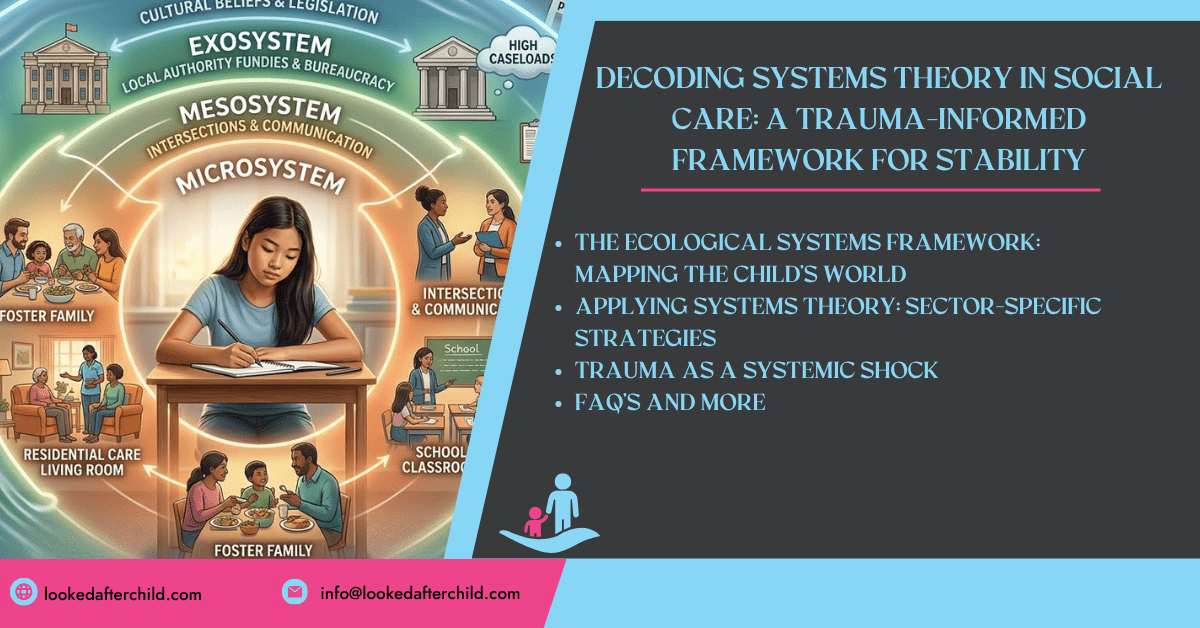
Systems theory in social care is an operational framework that views a child not in isolation, but as a central figure within a complex, interconnected network of environments—from their immediate residential placement to broader legislative structures. To create sustainable, trauma-responsive care, professionals must understand how a disruption in one part of a child’s system creates a ripple effect throughout their entire world.
As the Founder and Director of Looked After Child Limited, I approach this framework through a Dual Lens. Over the past seven years of frontline professional experience—serving as a House Manager and holding an NVQ Level 4 in health and social care—I have navigated the operational mechanics of these systems daily. Simultaneously, as a care-experienced survivor, I understand the profound, internal impact when these systems fracture. I have rewritten my ending, and my mission now is to equip you—foster parents, residential workers, and social workers—with the structural tools to help vulnerable children rewrite theirs.
Understanding systems theory is not just an academic exercise; it is a vital safeguarding tool. When we map a child’s world accurately, we can identify protective factors, predict placement instability before it happens, and engineer environments where genuine healing can occur.
Table Of Contents
- 1 The Ecological Systems Framework: Mapping the Child’s World
- 2 1. The Microsystem: The Immediate Environment
- 3 2. The Mesosystem: The Intersections
- 4 3. The Exosystem: Indirect Influences
- 5 4. The Macrosystem: Cultural and Societal Context
- 6 Applying Systems Theory: Sector-Specific Strategies
- 7 For Residential Workers and House Managers
- 8 For Foster Parents and Kinship Carers
- 9 For Social Workers
- 10 Trauma as a Systemic Shock
- 11 Frequently Asked Questions (FAQs)
The Ecological Systems Framework: Mapping the Child’s World
To operationalize systems theory, we primarily draw upon Urie Bronfenbrenner’s Ecological Systems Theory. This model categorizes a child’s environment into concentric circles of influence. When caring for looked-after children, we must constantly assess which layer of the system is providing stability and which is causing dysregulation.
1. The Microsystem: The Immediate Environment
The microsystem consists of the environments where the child has direct, daily interactions. For a looked-after child, this is their foster home, their residential care unit, their biological family (during contact), and their school.
- The Operational Reality: In a residential setting, the microsystem includes shift patterns, the physical environment of the home, peer dynamics, and the consistency of the staff team.
- The Trauma-Informed Focus: Children with complex trauma histories are hyper-vigilant to their microsystem. A sudden change in a staff rota or a poorly managed transition at the dinner table can trigger an acute trauma response. Stability here is the absolute foundation of therapeutic care.
2. The Mesosystem: The Intersections
The mesosystem is where different parts of the microsystem interact. It is not an environment itself, but the relationship between environments. Examples include a foster carer communicating with a teacher, or a social worker collaborating with a therapist.
- The Operational Reality: This is where the highest percentage of placement breakdowns originate. When a school excludes a child without communicating the triggers to the residential home, the mesosystem fractures.
- The Trauma-Informed Focus: Looked-after children often exploit fractures in the mesosystem (splitting behaviors) as a trauma-derived survival mechanism. Strong, transparent, and united communication between all adult stakeholders is a mandatory protective factor.
3. The Exosystem: Indirect Influences
The exosystem includes structures and decisions that affect the child, even though the child does not directly participate in them. This encompasses local authority funding decisions, a social worker’s high caseload, court proceedings, and care planning panels.
- The Operational Reality: A delayed decision from a funding panel regarding therapeutic intervention directly impacts the child’s daily life, despite the child never stepping foot in that boardroom.
- The Trauma-Informed Focus: Professionals must buffer the child from the anxieties of the exosystem. Transparency is important, but a child should never carry the emotional weight of systemic bureaucratic failures.
4. The Macrosystem: Cultural and Societal Context
The macrosystem represents the overarching cultural beliefs, societal stigmas, and legislative frameworks (such as the Children Act 1989 or the Online Safety Act) that dictate how care is delivered.
- The Operational Reality: Societal bias against care leavers impacts how a teenager views their own future.
- The Trauma-Informed Focus: Part of our role as advocates and leaders is to actively challenge the macrosystem, dismantling the stigmas that our young people internalize.
Applying Systems Theory: Sector-Specific Strategies
Understanding the theory is only the first step. The true value lies in operationalizing it across different roles within the social care sector.
For Residential Workers and House Managers
In a children’s home, you are the architects of the microsystem.
- Milieu Therapy: Recognize that the environment itself is the intervention. The tone of voice used during handovers, the predictability of routines, and the visual warmth of the home all regulate the child’s nervous system.
- Managing Shift Dynamics: A fractured staff team creates a fractured microsystem. House Managers must ensure that supervision and debriefs are rigorous, preventing staff burnout from destabilizing the home environment.
For Foster Parents and Kinship Carers
You provide the primary secure base.
- Navigating the Mesosystem: You are the bridge between the child and the external world. Actively build positive relationships with the child’s school and their biological family (where safe and appropriate).
- Systemic Boundaries: Understand that acting out behaviors at home may be the result of a disruption in another system (e.g., a difficult contact session or a change in social workers). Address the systemic root, not just the symptomatic behavior.
You are the orchestrators of the child’s wider network.
- Holding the Exosystem: Your role is crucial in managing the bureaucratic machinery so that carers can focus on the child. Advocate fiercely at panels and ensure that care plans are living documents that reflect the child’s current systemic needs.
- Mapping Protective Factors: Use systems theory during assessments to identify where a child has strong, positive connections. If their microsystem at home is unstable, can their mesosystem connection to a dedicated teacher serve as a temporary anchor?
Trauma as a Systemic Shock
When we view care through a trauma-responsive lens, we must understand that abuse, neglect, and placement breakdowns are not just isolated events; they are profound shocks to a child’s entire system. Trauma shatters the predictability of the microsystem and instills a deep mistrust of the mesosystem (the adults who were supposed to coordinate their safety).
To repair this, our interventions must be equally systemic. We cannot offer a child one hour of therapy a week (microsystem intervention) and expect them to heal if they are returning to a chaotic residential unit or facing imminent placement moves dictated by the exosystem. Healing requires systemic alignment. Every professional, every policy, and every daily routine must sing from the same trauma-informed hymn sheet.
By applying systems theory, we move away from reacting to a child’s distress and move towards proactively engineering environments that foster resilience, stability, and long-term success.
Frequently Asked Questions (FAQs)
1. How does applying systems theory actively improve placement stability? Systems theory improves stability by forcing professionals to look beyond the child’s immediate behavior. By analyzing the entire network (micro, meso, exo), we can identify external stressors—such as a lack of communication between school and home or delays in local authority support—and address them before they cause the child to dysregulate and the placement to break down.
2. How can residential workers use systems theory during an acute crisis? During a crisis, residential workers should immediately assess the microsystem. Is the environment currently safe, predictable, and calm? By intentionally regulating the physical space, managing peer dynamics, and ensuring staff present a united, calm front, workers can use the immediate system to help co-regulate the distressed child.
3. What is the difference between a trauma-informed and a trauma-responsive system? A trauma-informed system understands how trauma impacts a child’s development and behavior. A trauma-responsive system operationalizes that understanding. It means changing policies, daily routines, and environmental structures to actively prevent re-traumatization and promote healing, rather than just knowing the theory.
4. How do foster carers and frontline staff manage systemic failures outside their control, like local authority delays? While you cannot control the exosystem (bureaucracy, funding, court dates), you can control the mesosystem and microsystem. The operational strategy is to “buffer” the child. Maintain absolute consistency, warmth, and predictability in the home environment. Transparently but safely communicate with the child about delays, ensuring they know the adults are holding the problem, so they do not have to.

0 Comments