

Social pedagogy is a holistic framework for working with children and young people that integrates education and care into a single professional practice. It focuses on the “head, heart, and hands” to support the development of the whole person through meaningful, everyday relationships. In the context of looked-after children, it provides a systemic approach to improving placement stability and emotional well-being by seeing the child as an equal, competent individual.
Table Of Contents
As a Director with over seven years of frontline experience as a House Manager, and as someone who navigated the care system personally, I have seen the limitations of “service-led” care. Standardized procedures often fail to address the nuance of trauma. Social pedagogy shifts the focus from managing behavior to nurturing the human being. It moves us away from a “doing to” culture toward a “being with” culture, which is essential for trauma-responsive practice.
1. The Diamond Model: Unlocking Potential
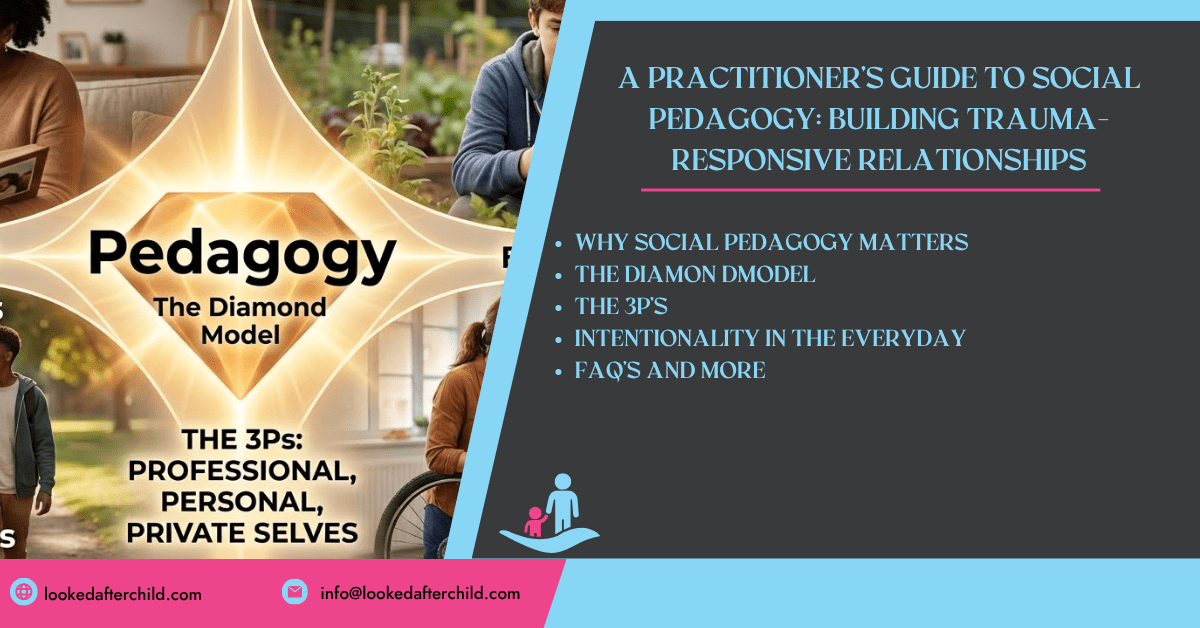
The Diamond Model is the core symbolic representation of social pedagogy. It is based on the belief that every child is a “diamond”—a precious individual with inherent value and potential, even if that potential is currently obscured by trauma or difficult circumstances.
The model focuses on four key areas:
- Well-being and Happiness: Prioritizing the child’s current emotional state rather than just future outcomes.
- Learning: Viewing every interaction—from cooking a meal to a walk in the park—as a learning opportunity.
- Empowerment: Giving children agency over their own lives and decisions.
- Positive Relationships: Establishing a secure base through authentic human connection.
For residential workers and foster parents, maintaining boundaries while being “authentic” is often the greatest challenge. Social pedagogy introduces the framework of the 3Ps:
- The Professional Self: This is the version of you that understands legislation, safeguarding, and the theory behind your actions. It is the “Director” or “Manager” lens.
- The Personal Self: This involves sharing your authentic personality, hobbies, and humor. It is what makes you relatable to a child who has been conditioned to distrust “the system.”
- The Private Self: This represents your personal life, family, and deep vulnerabilities that should never be shared with the child.
Effective practitioners use their Professional knowledge to decide how much of their Personal self to share, while keeping their Private life strictly separate to maintain safety and professional integrity.
3. The “Common Third”: Bridging the Gap
One of the most practical tools in our arsenal is the Common Third. This is a neutral activity or interest that sits between the adult and the child, allowing a relationship to develop without the pressure of direct, intense confrontation.
By engaging in a shared task—such as fixing a bike, baking, or playing a sport—the focus is on the activity rather than the “problem.” This reduces the power dynamic and allows the child to feel safe enough to communicate. In my experience leading residential teams, the most significant breakthroughs often happened while washing dishes or driving to school, not in formal key-work sessions.
4. Intentionality in the “Everyday”
In social pedagogy, the “lifespace” is the intervention. This means that the way we wake a child up, the way we sit at the dinner table, and the way we handle a crisis are all intentional acts of care.
- Shared Lifespace: We occupy the same space and time as the child.
- Holistic Approach: We consider the child’s physical, emotional, and social needs simultaneously.
- Reflection: Practitioners must constantly reflect on their own reactions to a child’s trauma-induced behaviors.
To embed social pedagogy into your organization or home, you must move beyond policy and into culture. This requires:
- Reflective Supervision: Moving beyond “task-checking” to discussing the emotional impact of the work.
- Stability-First Mentality: Recognizing that every transition is a potential trauma point.
- Language Matters: Shifting from clinical terms (e.g., “absconding”) to human terms (e.g., “running to feel safe”).
Frequently Asked Questions
How does social pedagogy differ from traditional social work?
Traditional social work often focuses on assessment, risk management, and statutory duties. Social pedagogy is more concerned with the “lived experience” and the daily relationship between the carer and the child. It is the practical application of care that happens in the hours between social worker visits.
Is the “Personal Self” dangerous for professional boundaries?
No, provided it is guided by the “Professional Self.” Sharing that you like a certain football team or have a hobby in gardening makes you a human being rather than a “placement provider.” It builds trust. The danger only arises when the “Private Self” (personal problems or trauma) is shared, which is a safeguarding failure.
Can social pedagogy be used with children who have severe behavioral challenges?
Yes. In fact, it is often more effective than traditional reward-and-punishment systems. By using the “Common Third” and focusing on the “Diamond Model,” we address the underlying need for connection rather than just the outward symptom of the behavior.
How do I explain the “Common Third” to a child?
You don’t necessarily need to explain it. You simply invite them into an activity. Instead of saying, “We need to talk about your school attendance,” you might say, “I’m going to try and bake this cake, want to help me with the icing?” The conversation about school often follows naturally once the child feels relaxed and connected through the task.
Does social pedagogy replace safeguarding procedures? Absolutely not. Social pedagogy works within the framework of safeguarding. It enhances safeguarding by building stronger relationships, which makes it more likely that a child will disclose concerns and feel safe enough to trust the adults looking after them.

0 Comments