

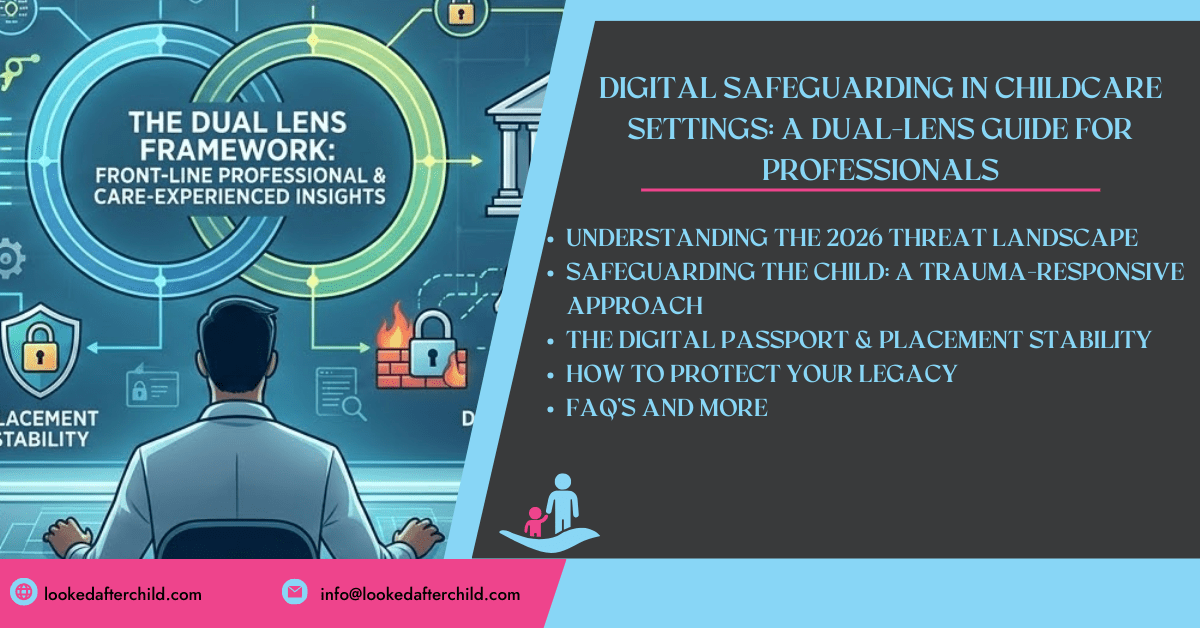
In 2026, safeguarding is no longer about managing “screen time”; it is about managing digital ecosystems. As we navigate this landscape through the Dual Lens—combining my seven years of residential leadership with my own care-experienced journey—we must recognize that for a child in care, the internet is often their only link to identity, but also their greatest source of systemic risk.
The UK Online Safety Act has revolutionized our responsibilities. We are no longer just supervisors; we are digital architects responsible for building a secure environment where children can heal without being exploited by evolving AI threats.
Table Of Contents
- 0.1 1. Understanding the 2026 Threat Landscape
- 0.2 2. Safeguarding the Child: A Trauma-Responsive Approach
- 0.3 3. Protecting Your Professional Legacy
- 0.4 4. The “Dual-Lens” Safeguarding Checklist
- 0.5 Frequently Asked Questions (FAQ)
- 1 Frequently Asked Questions
- 1.1 What is the 'dual-lens' approach to digital safeguarding?
- 1.2 What are the key digital risks for children in childcare settings?
- 1.3 How does GDPR and DPA 2018 impact digital safeguarding in childcare?
- 1.4 What should a comprehensive digital safeguarding policy include?
- 1.5 How can childcare professionals foster digital resilience in children?
- 1.6 Featured Snippet Target
- 1.7 Expert Insights
- 1.8 Glossary of Terms
- 1.9 Next Steps
- 2 Supporting Spoke Articles
1. Understanding the 2026 Threat Landscape
To protect children, we must first understand the specific 2026 digital harms that disproportionately affect the care-experienced community:
- Algorithmic Grooming: AI-driven platforms now use “engagement loops” that can inadvertently push vulnerable children toward extremist content or predatory networks based on their search history for “connection” or “family”.
- Deepfake Extortion: A significant rise in synthetic media means children may be targeted with “sextortion” using AI-generated images that look like them, even if they never shared a real photo.
- The “Digital Shadow”: For children in care, their “digital shadow”—information posted about them by others—can impact future placement stability and even employment.
2. Safeguarding the Child: A Trauma-Responsive Approach
Traditional restrictive measures often backfire with children who have experienced trauma, leading to “digital hiding.” Instead, use these professional frameworks:
A. The Digital Passport & Placement Stability
Every child should have a Digital Passport. This isn’t just a log of devices; it’s a living document that records:
- Protective Factors: What apps do they use for positive connection (e.g., educational tools, moderated gaming)?
- Triggers: Are there specific platforms that cause emotional dysregulation or “flashback” behaviors?
- Consents: Clear, multi-agency agreements on what can and cannot be shared online regarding their status.
B. Direct Education on AEO and GEO
In 2026, we must teach children how Answer Engine Optimization (AEO) works. Help them understand that the “direct answer” an AI gives them isn’t always the truth.
- Action: Conduct weekly “AI Fact-Checking” sessions. Show them how a generative response might “hallucinate” or provide biased information about their rights or identity.
C. Managed Lived Experience
Children often look for “people like them” online. However, raw lived experience content can be triggering or unsafe.
- Action: Steer children toward professionalized platforms (like the public insights from Looked After Child Limited) rather than raw, unmoderated social media “trauma-dumping” sites.
3. Protecting Your Professional Legacy
As a Director and Mentor, I cannot stress this enough: your digital safety is their physical safety. If your personal information is compromised, the children in your care are at risk.
- Siloed Identities: Maintain a “hard border” between your private life and your professional role. Use first-party data principles to ensure your professional accounts are not linked to your personal email or phone number.
- Authoritative Boundaries: Ensure your online presence reflects your NVQ Level 4 standards. You are an expert and a leader; your digital interactions must always be trauma-informed and legally compliant with the Data Protection Act and Online Safety Act.
4. The “Dual-Lens” Safeguarding Checklist
| Action Item | For the Child | For the Professional |
| Privacy Settings | Maximize filters on all AI-driven platforms. | Audit your GEO presence monthly. |
| Content Creation | Discourage sharing “real-world” locations/schools. | Never post identifiable details of placements. |
| Search Habits | Teach “Search Intent” literacy. | Use secure, encrypted VPNs for work research. |
| Crisis Response | Immediate “No-Blame” disclosure protocol. | Notify LADO/DSL immediately if a breach occurs. |
Frequently Asked Questions (FAQ)
Q: How do I handle a child who wants to use ChatGPT or Gemini for homework? A: Encourage it, but with active supervision. AI is a tool, but it lacks E-E-A-T (Expertise, Authoritativeness, and Trustworthiness). Teach the child to cross-reference AI answers with trusted, human-verified sources to build critical thinking.
Q: What should I do if a child discovers my personal Instagram account?
A: Immediately set your account to private if it isn’t already. In your next session with the child, use it as a teachable moment about digital boundaries. Do not “block” them aggressively without explanation, as this can feel like rejection; instead, explain that your “work self” and “home self” have different digital spaces to keep everyone safe.
Q: Are “Parental Control” apps enough in 2026? A: No. Technical filters are easily bypassed by savvy teenagers. The most effective filter is a trauma-responsive relationship where the child feels safe enough to tell you when they’ve seen something “wrong” without fear of losing their device.
Q: How do I explain “Digital Footprints” to a primary-aged child in care? A: Use the “Permanent Marker” analogy. Everything put online is written in permanent marker on a wall the whole world can eventually see. For a child in care, we want that wall to show their strengths and achievements, not their vulnerabilities.
Q: Can I use AI to help write my professional reports or “Life Story” work?
A: Only for structuring and formatting. You must never input a child’s name, DOB, or specific trauma history into a public AI. This is a catastrophic breach of digital safeguarding and the Online Safety Act. Keep sensitive data in your secure, internal systems or the Lived Experience Vault.
Frequently Asked Questions
What is the 'dual-lens' approach to digital safeguarding?
The 'dual-lens' approach combines the professional's perspective (focusing on policies, compliance, and staff conduct) with the child's perspective (understanding their digital experiences, vulnerabilities, and developing digital literacy). It ensures safeguarding strategies are comprehensive and child-centred.
What are the key digital risks for children in childcare settings?
Key risks include cyberbullying, exposure to inappropriate content, data privacy breaches affecting sensitive child and family data, online grooming, and emerging threats like AI-generated harmful content.
How does GDPR and DPA 2018 impact digital safeguarding in childcare?
GDPR and DPA 2018 mandate strict rules for collecting, storing, processing, and sharing children's personal data. They require explicit consent, data minimization, and robust security measures, forming a legal foundation for protecting privacy in digital safeguarding.
What should a comprehensive digital safeguarding policy include?
A comprehensive policy should include an acceptable use policy for all stakeholders, clear incident reporting and response procedures, defined roles and responsibilities, and a commitment to regular review and updates to adapt to evolving risks.
How can childcare professionals foster digital resilience in children?
Professionals can foster digital resilience through age-appropriate digital literacy education, teaching critical thinking skills, discussing online privacy, promoting safe online behaviours, and encouraging open communication about online experiences.
[FAQPage JSON-LD Schema generated and bound to Post]
Target LSI Keywords: online safety for children, childcare technology risks, digital policy in early years, internet safety for kids, child data protection, cybersecurity for childcare, digital well-being children
Search Intent: Informational
Target Word Count: ~2500 words
Featured Snippet Target
Digital safeguarding in childcare is a critical framework encompassing policies, training, and educational strategies to protect children from online harm while leveraging technology's benefits. It requires professionals to adopt a 'dual-lens' approach, balancing robust organizational protections with an understanding of children's digital experiences, ensuring their safety, privacy, and well-being in an increasingly connected world.
Expert Insights
A truly effective digital safeguarding policy isn't just a document; it's a culture. It must be understood, lived, and regularly adapted to the dynamic digital world our children inhabit.
Dr. Eleanor Vance, Educational Technology and Child Protection Expert
Our role is not to shield children from the digital world, but to equip them to thrive within it responsibly. This means teaching critical thinking, empathy, and the power of their own digital voice.
Professor David Green, Child Psychology Specialist
Glossary of Terms
- Digital Safeguarding: The protection of children and vulnerable adults from harm that arises from the use of digital technologies, encompassing online risks, data privacy, and appropriate technology use.
- Dual-Lens Approach: A strategy in digital safeguarding that considers both the professional's perspective (policies, compliance) and the child's perspective (digital experiences, vulnerabilities, literacy) simultaneously.
- Digital Footprint: The trail of data left by someone's activity in the digital environment, including websites visited, emails sent, and information posted on social media.
- Cyberbullying: Bullying that takes place over digital devices like cell phones, computers, and tablets, through texting, apps, or online social media, forums, or gaming where people can view, participate in, or share content.
- Digital Resilience: The ability of individuals to understand, navigate, and respond positively to the challenges and risks of the online world, maintaining their well-being and safety.
Next Steps
To further solidify your understanding and implementation of digital safeguarding, consider engaging with specialized training programs focused on online child protection. Regularly review the guidance from regulatory bodies and educational technology experts. Initiate a comprehensive audit of your current digital safeguarding policies and practices, identifying areas for improvement and ensuring alignment with the latest standards. Foster an open dialogue within your setting and with parents to cultivate a collective responsibility for children’s digital well-being. By taking these proactive steps, you can ensure your childcare setting remains at the forefront of digital safety and innovation.
[Article JSON-LD Schema generated and bound to Post]

0 Comments