Placement Stability

Strategies and interventions aimed at maintaining consistent and secure care placements for children.

Conducting a Comprehensive Sibling Assessment: Best Practices for Social Workers

Learn best practices for social workers conducting comprehensive sibling assessments. This guide emphasizes a child-centered, trauma-informed approach to safeguard vital sibling bonds, inform permanence planning, and support the well-being of children within the care system, ensuring decisions prioritize their unique needs and relationships.

read more...

The Child’s Right to be Heard: Meaningful Participation in Care Decisions

Explore the child’s fundamental right to be heard in care decisions, examining its legal basis, the benefits of meaningful participation, challenges faced, and practical strategies to empower children’s voices for better care outcomes and enhanced well-being.

read more...

Achieving Stable Placements: A Professional Guide to the Matching Process in Social Care

Explore the critical matching process in social care, detailing professional considerations, challenges, and best practices for achieving stable and nurturing placements for children and young people in care. This guide emphasises the profound impact of stability on child development and well-being.

read more...

Types of Care Placements for Looked After Children

Explore the diverse types of care placements for looked after children, from various forms of foster care to residential settings and supported accommodation. Understand how each placement type is designed to meet individual needs, promoting stability, safety, and well-being for children within the care system.

read more...
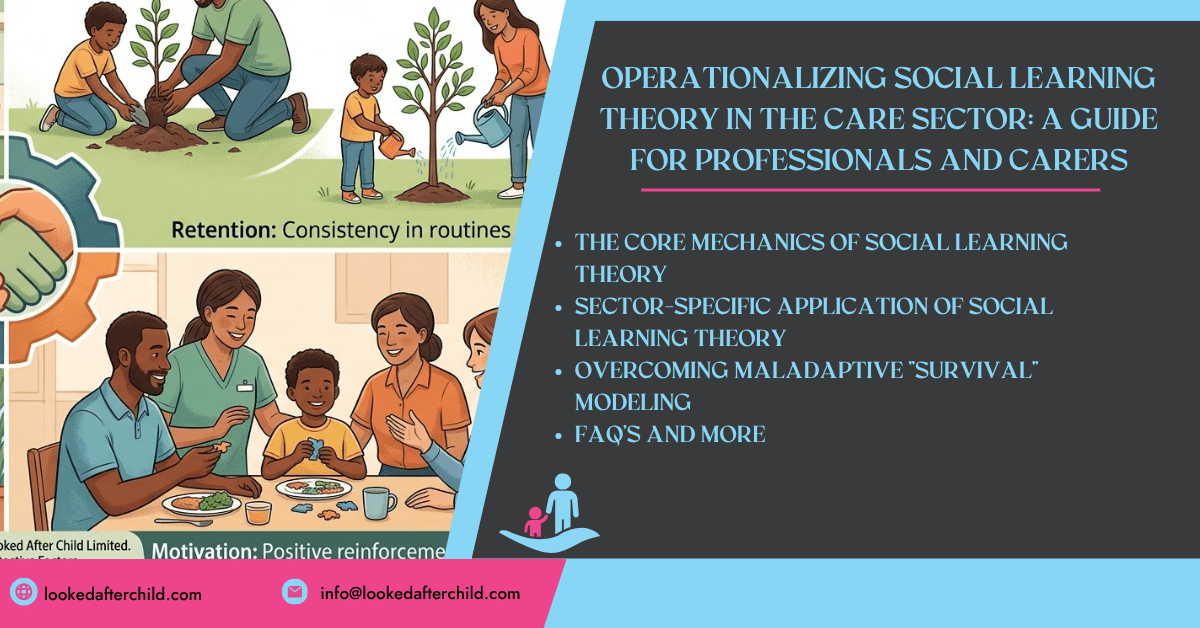
Infographic titled 'Operationalizing Social Learning Theory in the Care Sector: A Guide for Professionals and Carers'. It features illustrations of a man and boy planting a tree, a boy watering a plant, and a diverse family sharing a meal, representing consistency in routines and positive reinforcement. The guide outlines key topics: core mechanics of social learning theory, sector-specific application, overcoming maladaptive 'survival' modeling, and FAQs, providing essential trauma-informed tools for supporting children in care.

Operationalizing Social Learning Theory in the Care Sector: A Guide for Professionals and Carers

Social Learning Theory, pioneered by Albert Bandura, establishes that individuals learn behaviors, emotional reactions, and attitudes through the observation and imitation of others. For professionals and carers looking after children, this theory is not just an academic concept; it is the...

read more...
Icon depicting an adult and child holding hands, cradled by a protective hand, symbolizing the trauma-informed support and care provided for children in care by Looked After Child Limited.

Make a Lasting Difference


Every child deserves an environment where they feel safe, heard, and valued. Sign up to the Looked After Child Limited newsletter to learn more about our fostering and residential care communities, receive guidance on starting your career in care, and discover how you can support positive outcomes for vulnerable young people.

You have Successfully Subscribed!