


The "Local Care Offer" (officially known as the Local Offer for Care Leavers) is a document or website that every local authority in England must publish by law. It lists all the services, support, and entitlements available to young people aged 16 to 25 who have been in care.
Think of it as your "rights and rewards" menu. It details exactly what your council must do for you (statutory rights) and the extra things they choose to do for you (discretionary support) to help you transition into adulthood.
Li’s Note: "When I left care, I had to fight to find out what I was entitled to. Today, the law says you shouldn't have to fight—it should be written down, clear as day. If it’s in the Offer, it’s a promise."
Who is the Local Offer for?
You are eligible for the Local Offer if you are a Care Leaver. You generally fit into one of these categories:
- Eligible: Aged 16/17 and currently in care (and have been for at least 13 weeks since age 14).
- Relevant: Aged 16/17 but have left care.
- Former Relevant: Aged 18-25 and were previously "Eligible" or "Relevant".
- Qualifying: You spent some time in care (at least 24 hours) after age 16 but don’t fit the categories above (e.g., under a Special Guardianship Order).
What is included in the Local Care Offer?
According to the Children and Social Work Act 2017, the offer must cover six key areas:
1. Housing and Accommodation
This is often the biggest worry for care leavers. The offer should detail:
- Priority status for social housing.
- Council Tax exemptions (many councils now exempt care leavers until age 25).
- Setting Up Home Grant: A pot of money (often £2,000–£3,000) to buy furniture and essentials for your first flat.
2. Education, Employment, and Training (EET)
Support to help you succeed in your career, such as:
- Higher Education Bursary: A statutory payment of £2,000 if you go to university.
- Apprenticeships: Ring-fenced opportunities specifically for care leavers within the council.
- Laptop/Internet access: Support for digital inclusion.
3. Health and Wellbeing
- Access to mental health support tailored for care leavers.
- Free prescriptions or gym memberships (in some areas).
- Personal Adviser (PA): You have the right to a PA until you are 25 to guide you through these services.
4. Finance
- Advice on budgeting and managing debt.
- Emergency financial assistance.
5. Relationships
- Support to maintain contact with siblings or former foster carers.
- Mentoring schemes.
6. Participation in Society
- Voting registration help.
- Access to leisure groups or participation forums (like a Children in Care Council).
Is the "Local Offer for SEND" the same thing?
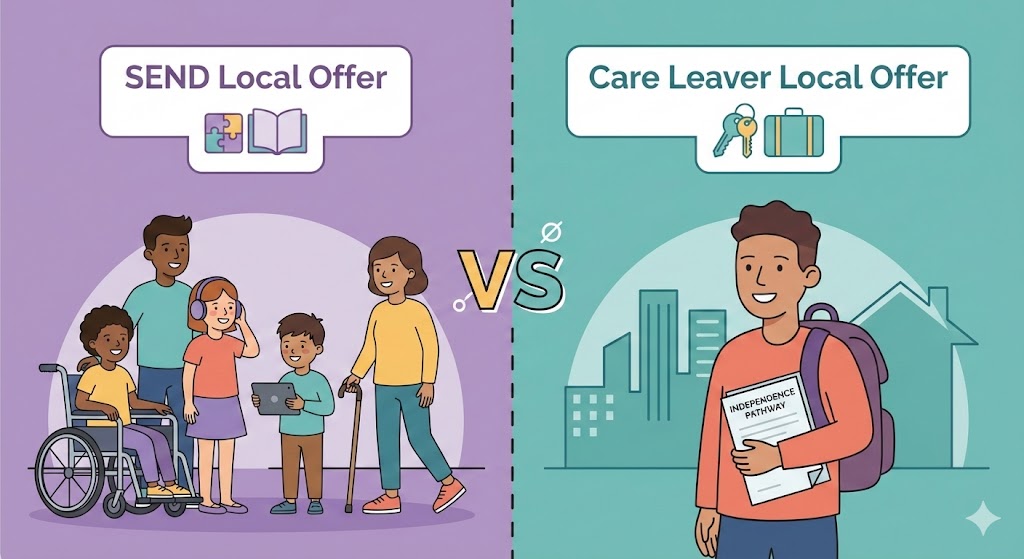
No. This is a common point of confusion.
- The Local Offer for SEND is for children/young people (0-25) with Special Educational Needs and Disabilities.
- The Local Offer for Care Leavers is specifically for those with care experience.
- Note: If you are a care leaver with SEND, you may be entitled to support from both offers.
How do I find my Local Offer?
Every council must publish this on their website. https://www.careleaveroffer.co.uk/
- Search: Type "[Your Council Name] Local Offer for Care Leavers" into Google.
- Ask your PA: Your Personal Adviser is legally required to share this information with you.
- Check Coram Voice: They have a directory of offers across the country.
Li’s Top Tips for Professionals
- Don't just email the link: Sit down with the young person and go through the offer line-by-line.
- Challenge the "Postcode Lottery": If a neighbouring borough offers a Council Tax exemption and yours doesn't, use the Local Offer as a tool for advocacy.
- Update it: The offer should be reviewed regularly with feedback from care leaver
The Financial "Big Ticket" Items
These are the specific numbers you should be looking for. If your local authority’s offer is lower than these government recommendations, you have grounds to ask "Why?".
- Setting Up Home Grant (Leaving Care Allowance):
- The Number: Since April 2023, the Government recommendation for this grant has been £3,000 (increased from £2,000).
- What it's for: Furniture, white goods (fridge/washing machine), and essentials for your first independent tenancy.
- Li’s Tip: Don’t spend this all at once. Ask if you can access it in stages. Also, some councils allow you to use a portion of this for a deposit, but others have separate "Rent Deposit Schemes"—always ask for the separate scheme first so you don't eat into your furniture money.
- Higher Education (HE) Bursary:
- The Number: If you go to university, you are legally entitled to a minimum £2,000 bursary over the course of your degree.
- The Extra: Many universities match this with their own "Care Leaver Bursaries," which can be worth thousands more. Check the university's specific offer, not just the council's.
- Council Tax Exemption:
- The Standard: Many councils now offer 100% Council Tax relief for care leavers living alone, usually up to age 25.
- The Detail: If you live with others, you might still get a discount (e.g., you are "disregarded" for the tax calculation, meaning the household is treated as having one fewer adult).
These are items that aren't strict laws for every council but are common in "good" Local Offers. Check your specific document for these:
- Digital Access:
- Grants for a laptop (often around £500) or 12 months of free broadband/WiFi when you move into your own place.
- Driving Lessons:
- Many councils will pay for a set number of lessons (e.g., a block of 10) or cover the cost of your theory and practical tests, recognizing that driving is a key employability skill.
- Health & Wellbeing:
- Free Prescriptions: Some regions (like Greater Manchester or North East London) offer free prescriptions for care leavers up to age 25.
- Gym Passes: Free or heavily discounted access to council-run leisure centers and swimming pools.
- Travel:
- Free bus travel passes are becoming common in major combined authorities (like London and Manchester).
Advocacy: How to Challenge a Weak Offer
If you ask for support and your Personal Adviser (PA) says "we don't do that here," do not just accept it. Use the Corporate Parenting Principles.
The "Is This Good Enough for Your Child?" Test Under the Children and Social Work Act 2017, the council must act as a "Corporate Parent." This means they must ask: "Would this be good enough for my own child?".
Steps to Challenge:
- Check the Document: Find the published Local Offer on their website. If the service is listed there, they must provide it.
- Request a Review: If you are denied a service (like the £3,000 grant), ask for the decision in writing.
- Use the "Postcode Lottery" Evidence: If a neighboring council offers £3,000 and yours offers £2,000, ask your Corporate Parenting Board why your area values its children less. This is a powerful advocacy tool.
Frequently Asked Questions
Who is eligible for the Local Care Offer?
Eligibility for services under the Local Care Offer is determined through an assessment of individual needs, typically conducted by the local authority. This assessment considers factors such as age, disability, health conditions, and social circumstances to ensure support is directed where it is most required.
How is the Local Care Offer funded?
The Local Care Offer is typically funded through a combination of central government grants, local taxation (council tax), and contributions from partner organisations such as NHS trusts. Funding mechanisms are designed to support the integrated delivery of care and support services.
What is the difference between local care and national care services?
The Local Care Offer focuses on services planned and delivered within a specific geographical area by local authorities and their partners, tailored to local needs. National care services refer to broader frameworks, policies, or institutions that operate across the entire country, such as NHS England's national guidelines or central government social care policies, which local offers must adhere to.
How can I access the Local Care Offer in my area?
To access the Local Care Offer, individuals should typically contact their local authority's social services department. They will provide information on how to request an assessment of needs and guide you through the available support and services in your specific area.
[FAQPage JSON-LD Schema generated and bound to Post]
Target LSI Keywords: Community care, Social services, Integrated care, Public services, Care provision, Local authority, Health and social care, Well-being, Support services, Early intervention
Search Intent: Informational
Target Word Count: ~2000 words
Featured Snippet Target
The Local Care Offer is a comprehensive framework outlining the range of care, support, and services available to residents within a specific geographical area, typically managed by local authorities. It aims to ensure that individuals of all ages, particularly those with complex needs, disabilities, or vulnerabilities, receive timely and appropriate assistance to promote their wellbeing and independence.
Expert Insights
The Local Care Offer is the blueprint for true integration, moving us from siloed services to a cohesive ecosystem where individuals are at the centre of their support journey.
Dr. Eleanor Vance, Director of Public Health Integration
The future of the Local Care Offer lies in its agility – its ability to adapt to demographic shifts, technological advancements, and the ever-changing tapestry of human need, always prioritising the individual's journey.
Dr. Anya Sharma, lead researcher in Integrated Public Services
Glossary of Terms
- Local Care Offer: A strategic framework developed by local authorities outlining the range of care, support, and services available to residents in their area.
- Integrated Care: A coordinated approach to service delivery where different health, social care, and other support agencies work together seamlessly to provide holistic care.
- Early Help: Support provided to children, young people, and their families as soon as problems emerge, aiming to prevent issues from escalating and reduce the need for more intensive interventions later.
- Safeguarding: Measures taken to protect the health, wellbeing, and human rights of individuals, especially children and vulnerable adults, from harm, abuse, and neglect.
Next Steps
To explore specific services or understand how the Local Care Offer applies to your personal situation, engage directly with your local authority's social services department or visit their official website for detailed local guidance and contact information. Further research into related articles on eligibility and access can also provide valuable insights.
[Article JSON-LD Schema generated and bound to Post]

0 Comments